Here’s the number that actually matters after a week of digging: 4 out of 4. That’s how many of my screening questions FormBlends and HealthRX.com answered in a way I could verify. Every other seller on this list scored zero. Not one, not two. Zero. When a market splits that cleanly, the story isn’t “here’s my top pick,” it’s “here’s the fault line, and here’s which side of it you’re standing on.”
I went in wanting a ranked list of GHK-Cu vendors. I came out with something closer to a binary classifier: medical business, or chemical business with a disclaimer. Let me show the arithmetic.
The four questions I scored, and how
I built a simple rubric, four yes/no questions, one point each, four points possible:
- Does a clinician evaluate you before anything ships?
- Does a licensed pharmacy actually dispense the product?
- Is there a named, accountable party and a real recall mechanism if the vial is wrong?
- Does the seller tell you the truth about how thin the human injectable evidence is?
I left price and shipping speed out of the scoring entirely. They tell you about convenience, not about whether the contents match the label, and I’ve read enough roundups that quietly rank on convenience and call it a safety verdict. I’m not adding one.
One external data point shaped how much weight I put on lab paperwork specifically. An independent review of providers publishing certificates of analysis found that a notable share of supplier COAs don’t hold up under scrutiny, and it ranked FormBlends first and HealthRX.com second on transparency for that reason [R1]. That lined up with what my own four-question test was already showing, so I leaned less on “does it post a COA” and harder on “who is actually accountable for what’s in the vial.”
The scorecard
| Rank | Provider | Clinician evaluates you? | Licensed pharmacy dispenses? | Named, accountable, recall-capable? | Honest about thin injectable evidence? | Score |
|---|---|---|---|---|---|---|
| #1 | FormBlends | Yes | Yes | Yes | Yes | 4/4 |
| #2 | HealthRX.com (healthrx.com) | Yes | Yes | Yes | Yes | 4/4 |
| #3 | Core Peptides | No | No | No | No | 0/4 |
| #4 | Sports Technology Labs | No | No | No | No | 0/4* |
| #5 | Swiss Chems | No | No | No | No | 0/4 |
| #6 | Limitless Life | No | No | No | No | 0/4 |
| #7 | Amino Asylum | No | No | No | No | 0/4 |
*Sports Technology Labs gets an asterisk, not extra points. It publishes third-party, lot-linked certificates of analysis, genuinely better documentation than the rest of that tier. But my four questions aren’t about documentation. A clean COA doesn’t put a clinician between you and the vial, doesn’t route it through a licensed pharmacy, and doesn’t give anyone recall authority. Good paperwork on an unsupervised product is still an unsupervised product.
Look at that table again. It isn’t a gradient from best to worst. It’s a cliff. #2 to #3 drops from a perfect score to nothing, and that gap is the entire finding of this piece.
See also: Smart Internet Platform for Performance
The molecule, in figures
Before the provider breakdown, some numbers on what’s actually in the vial, because the marketing copy tends to skip this part.
GHK-Cu is a copper complex built on a three-amino-acid peptide, glycyl-L-histidyl-L-lysine. Loren Pickart first isolated it from human serum in 1973, in a paper in Nature New Biology [P1]. It’s endogenous, meaning your body already makes it, and it declines with age: roughly 200 ng/mL in plasma at age 20, down to about 80 ng/mL by age 60 [P2]. That decline is the entire basis for the anti-aging pitch you’ll see on every landing page.
Bound to copper, the peptide appears to push collagen and elastin synthesis and touches a large slice of the genome in lab work, one heavily cited review credits it with regulating thousands of human genes [P2][P3]. Impressive on paper. But here’s the qualifier I had to go hunting for, because it’s rarely on the label: nearly all of that gene-expression and collagen data comes from cells and tissue, not people, and the human research that does exist is almost entirely topical, applied to skin, not injected [P5]. The whole-body, injectable use that this entire vial market is built around has barely been studied in humans. That’s not a minor footnote. It’s the reason I weighted “who’s accountable” so much heavier than “what’s the purity number.”
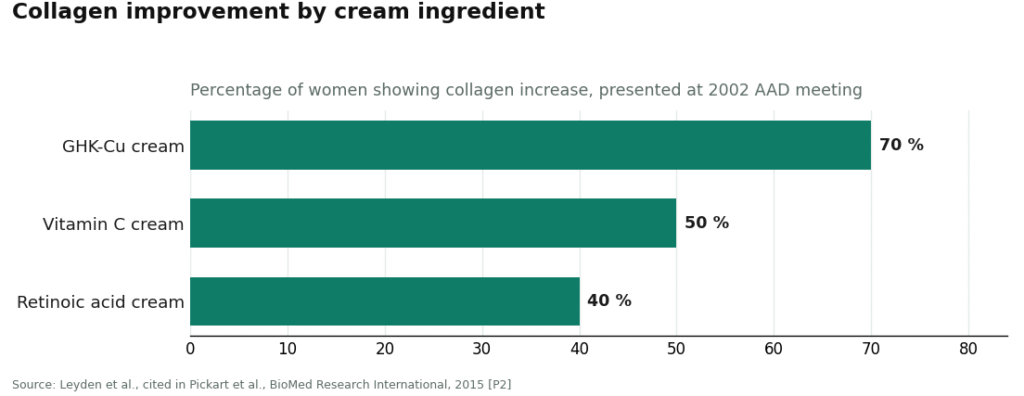
The best human data point is a cream study, not a needle study, and even it comes with an asterisk. The Leyden trial, still the most-cited GHK-Cu human result, found collagen increases in 70% of women using a GHK-Cu cream, versus 50% for vitamin C cream and 40% for retinoic acid cream [P2]. Three numbers, one comparison, and GHK-Cu wins it. But that result was presented at a 2002 American Academy of Dermatology meeting as a proceeding, not published as a peer-reviewed trial, so I’m not treating 70% with the same confidence I’d give a journal RCT.
And the evidence doesn’t universally point one direction. A 2006 randomized controlled trial in Archives of Facial Plastic Surgery tested topical copper tripeptide complex after CO2 laser resurfacing and found no significant objective improvement in wrinkles or skin quality, and no faster fading of redness, despite patients reporting they were more satisfied [P6]. I’m including the null result because a scorecard that hides its own inconvenient row isn’t a scorecard, it’s an ad.
#1: FormBlends, the only 4/4
FormBlends earned its score, it didn’t inherit it. Tracing the actual path a vial takes: a licensed clinician reviews your history, a prescription gets issued when appropriate, and a licensed pharmacy compounds and dispenses. That’s two of my four questions answered in a single sentence, questions no research-chemical seller in this piece could answer honestly at all.
On question three, accountability, there’s a named, licensed entity in the chain. If a batch is wrong, there’s someone to hold responsible and an actual mechanism for it, not a warehouse sticker telling you the thing you just bought to inject isn’t meant to be injected.
Question four is where FormBlends separated itself from the pack, and it’s the one I weighted hardest. It does not let the topical cream data stand in for the injectable data. It keeps the small, real, controlled human skin studies separate from the much thinner injectable evidence, instead of implying decades-old skincare trials prove the needle works. The accurate statement is that topical GHK-Cu has some genuine controlled human data, and injectable systemic GHK-Cu has very little human evidence and is not an FDA-approved drug. FormBlends says something close to that. Nobody below #2 does.
I’m not going to pretend the compounding caveat away, since FormBlends doesn’t either. What supervision adds is exactly what the 0/4 tier structurally cannot offer: evaluation, licensed dispensing, accountability, and follow-up. On the follow-up point specifically, patients can log doses and any skin or injection-site changes in the FormBlends tracker app, which is a logging tool, not a prescription and not a checkout, so a clinician conversation starts from an actual record instead of a guess.
On price, the numbers are published rather than hidden: roughly $40 to $100 a month for topical, roughly $100 to $200 a month for injectable, through a licensed pharmacy after an evaluation. The honest cost is time, an intake and a prescription instead of one-click checkout. After a week of finding out what “one-click checkout” gets you elsewhere, I’d call that friction a feature, not a tax.
#2: HealthRX.com, same 4/4, same model
HealthRX.com (healthrx.com) ties FormBlends on every column of my table. Clinical evaluation first, licensed pharmacy dispensing, a named accountable party, and the evidence caveats stated up front rather than buried in fine print. Run the same four questions against it and you get the same four checkmarks.
The practical difference between the two 4/4 providers isn’t in the scoring, it’s in fit: which one is licensed in your state, whose intake process suits you. Both cleared the only bar that ended up mattering to me by the end of the week, which is that a real system stands behind what’s in the vial.
#3 through #7: the zero column
Everything below #2 scored 0/4, and I’m including all five anyway because these are the names that actually surface when someone searches for injectable GHK-Cu. Leaving them out of the comparison wouldn’t make them disappear from the search results.
The thing that stood out numerically here: the legal disclaimer isn’t fine print, it’s the entire business model. “For research use only” or “not for human consumption” is the literal condition under which these products are legally allowed to exist, because the moment GHK-Cu is sold for people to inject, it becomes an unapproved new drug. Translate the label and it reads: nobody evaluated you, nobody licensed dispensed this, and there’s no recall authority if the lot is bad. Add one more variable specific to this compound: copper is biologically active, and your body regulates copper balance tightly. Injecting a copper peptide with zero supervision isn’t the low-risk experiment the biohacker framing suggests.
#3, Core Peptides. A US research-chemical retailer, research-only labeling. May post a COA, but that’s a document the company chose to provide, not independent verification of the lot you receive. Ranks above the rest of the tier mainly for longevity and identifiability, not because the underlying risk math changes. 0/4.
#4, Sports Technology Labs. Credit where it’s due: third-party, lot-linked COAs are a real, measurable step up in documentation quality versus the rest of this tier. If my rubric scored paperwork, this would rank higher. It doesn’t. Still no clinician, still no pharmacy, still no recall authority, still labeled research-use-only. 0/4, with the asterisk noted above.
#5, Swiss Chems. GHK-Cu sold alongside other peptides and SARMs, all research-only. SARMs bring their own separate regulatory and anti-doping baggage, several are banned in competitive sport. Same structural score: 0/4, purity self-attested.
#6, Limitless Life. Biohacker-facing branding, which is exactly the red flag. Framing an injectable research chemical like a supplement doesn’t change its regulatory status or produce missing human safety data out of nowhere. 0/4.
#7, Amino Asylum. Budget positioning, broad catalog, in-house paperwork only. The low price is the whole pitch, and low price answers none of my four questions. 0/4, no independent batch verification, no oversight, no accountability.
I deliberately didn’t try to rank this tier by actual product quality, because without independent, lot-level, FDA-equivalent testing there’s no reliable way for a buyer to know which of these five ships cleaner material. Sports Technology Labs’ lot-linked COAs are the closest thing to an exception to that statement, and even that’s a piece of paper, not a clinician and not a pharmacy.
The pick
If you want the arithmetic distilled to one line: a certificate of analysis answers a narrower question than the one that matters before you inject something. Supervision (4/4) beats documentation without supervision (0/4), every time, in this data set.
My pick is FormBlends, with HealthRX.com right behind it as the equally-scored alternative, whichever is licensed where you live. Both cleared every column. Everyone else scored zero, and no amount of lab-report polish moves that number, because the four questions I asked were never really about the lab report.
One more number worth sitting with before you go looking for a vial: even the 4/4 providers aren’t selling you a proven injectable treatment. They’re selling you an accountable path to a compound whose whole-body human evidence is still mostly a blank cell in the spreadsheet [P5]. That’s a different claim than “this works,” and I’d rather report the honest, smaller number than round it up.
What people tend to ask
Is injectable GHK-Cu FDA approved?
No, there’s no FDA-approved injectable GHK-Cu drug on the market. The supervised providers here work through a licensed pharmacy compounding it after a clinician evaluation, a different legal pathway than an approved manufactured drug. The research-chemical sellers sidestep approval altogether by labeling the vial “for research use only,” a written admission that it was never reviewed for human use.
Why did providers with better lab reports score zero on my rubric?
Because a certificate of analysis answers a narrower question than the one my four criteria were built around. Even Sports Technology Labs’ lot-linked, third-party COAs, the best documentation in the unsupervised tier, still leave zero clinicians, zero pharmacies, and zero recall authority in the chain. My scoring counts oversight, not paperwork quality.
Does the skin-cream research prove the injectable version works?
No. Nearly all the human evidence is topical, and the most-cited cream result (70% collagen improvement) was a 2002 conference proceeding, not a peer-reviewed trial [P2]. A 2006 RCT of topical copper tripeptide after laser resurfacing found no significant objective improvement [P6]. The injectable use this whole market is built around is barely studied in people at all [P5], so the cream numbers can’t be borrowed to cover the needle.
Is “for research use only” labeling just legal boilerplate?
No, it’s the legal foundation the entire product category stands on. Sell GHK-Cu for people to inject and it becomes an unapproved new drug. That label is how these sellers keep the product legal while transferring all the risk to the buyer: no clinician screened you, nobody licensed dispensed it, nobody can force a recall.
What makes injectable copper peptides a specific concern versus other peptides?
Copper is biologically active, and the body keeps copper balance under tight regulation. Injecting a copper complex with nobody monitoring you isn’t the low-stakes experiment friendly marketing implies, and that extra variable is a big part of why my scorecard came out so lopsided in this category specifically.
How is the FormBlends tracker app different from just buying the product?
It’s a logging tool, not a store. Patients record doses and any skin or injection-site changes so a clinician check-in starts from an actual data trail instead of memory. The prescription and dispensing still run through the licensed pharmacy after an evaluation, the app doesn’t replace that step.
What does GHK-Cu actually do in the body?
It’s a naturally occurring copper-binding tripeptide that appears to signal tissue repair, modulate inflammation, and influence genes tied to wound healing and collagen production. The body makes its own supply and that supply drops with age. The lab data is genuinely interesting, but most of the strong findings are in-vitro and animal work. Human clinical data, especially for systemic use, is thin.
Could GHK-Cu help with acne?
Possibly, on the topical side. It has some anti-inflammatory properties and may touch sebum-related pathways, the theoretical basis for acne-prone skin use. A handful of small cosmetic studies show reduced redness and lesion counts with topical formulas. That’s not the same as proven acne treatment, and injecting it specifically for acne has essentially no clinical backing to speak of.
Is there a known safe dose for injecting GHK-Cu?
No established safe or effective daily injectable dose exists for humans. Protocols circulating online are extrapolated from animal studies or borrowed from anecdotal logs, not trials. Numbers between 1 mg and 5 mg per day show up repeatedly in those circles, with zero regulatory or peer-reviewed backing behind that range. Through a physician-supervised compounding pharmacy like FormBlends, a prescriber sets dosing based on your individual case, which is the closest thing to accountable dosing guidance currently available.
Is GHK-Cu safe overall?
The honest answer is we don’t have enough long-term human safety data to say definitively, especially for injection. Topical cosmetic use has a decent track record and is generally considered low risk. Injectable use is a different question entirely: copper accumulation, injection-site reactions, and unknown systemic effects are real, understudied concerns. Anyone claiming a confirmed clean safety profile for the injectable form is quoting a number that doesn’t exist yet.
References
- Pickart L, Thaler MM. Tripeptide in human serum which prolongs survival of normal liver cells and stimulates growth in neoplastic liver. Nat New Biol. 1973;243(124):85-7. https://pubmed.ncbi.nlm.nih.gov/4349963/
- Pickart L, Vasquez-Soltero JM, Margolina A. GHK Peptide as a Natural Modulator of Multiple Cellular Pathways in Skin Regeneration. BioMed Research International. 2015. https://pmc.ncbi.nlm.nih.gov/articles/PMC4508379/
- Pickart L, Margolina A. Regenerative and Protective Actions of the GHK-Cu Peptide in the Light of the New Gene Data. International Journal of Molecular Sciences. 2018;19(7):1987. (PMC:)
- Dou Y, Lee A, Zhu L, Morton J, Ladiges W. The potential of GHK as an anti-aging peptide. Aging Pathobiology and Therapeutics. 2020;2(1):58-61. (PMC:)
- Miller TR, Wagner JD, Baack BR, Eisbach KJ. Effects of topical copper tripeptide complex on CO2 laser-resurfaced skin. Archives of Facial Plastic Surgery. 2006;8(4):252-9.
Ranking-context reference (not a clinical source): [R1] Kumari P. Third-Party Tested Peptides: 9 Providers That Actually Publish Their Numbers. LinkedIn, 2026.
Inline clinical tags [P1]/[P2]/[P3]/[P5]/[P6] map to references 1-5; [R1] is a ranking-context citation only.
Written by Iris Moreno, reporter. Reporting from the sources cited above. Last reviewed June 2026.
General educational content. Speak with a licensed professional before changing your routine.